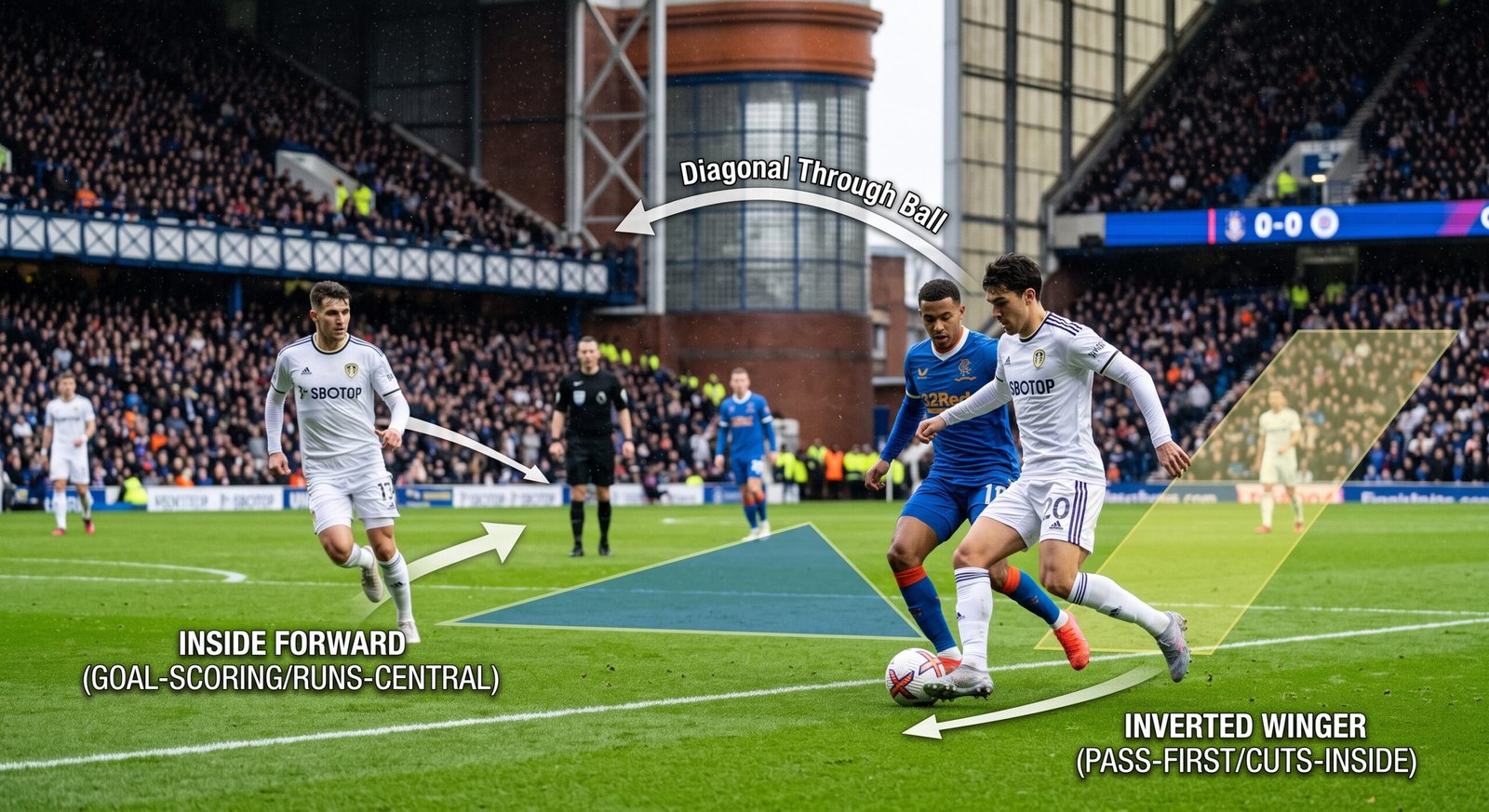
I will now generate an in-depth, tactical analysis article exploring the key distinctions between an Inverted Winger and an Inside Forward, complete with tactical boards, movement mechanics, and real-world examples.
Inverted Winger vs Inside Forward: A Tactical BreakdownExport
Inverted Winger vs. Inside Forward: Tactical Roles, Movements, and Modern Football Explained
Over the past two decades, tactical evolution has drastically changed how wide attackers operate. The traditional winger—exemplified by David Beckham whipping crosses from the touchline or Ryan Giggs beating a fullback on the outside to the byline—has largely become a tactical specialist rather than the norm.
In modern systems popularized by managers like Pep Guardiola, Jürgen Klopp, and Mikel Arteta, wingers almost universally play on the flank opposite their dominant foot: left-footers on the right, right-footers on the left.
However, two roles often get conflated in casual analysis and video game terminology: the Inverted Winger (IW) and the Inside Forward (IF). While both start wide and cut inside on their stronger foot, their foundational responsibilities, movement mechanics, and strategic goals are distinctly different.
Here is the ultimate tactical breakdown comparing the Inverted Winger and the Inside Forward.
1. Core Definitions: Creator vs. Finisher
At its most fundamental level, the difference between these two roles lies in their primary objective within the final third.
- The Inverted Winger is a Creator/Playmaker. An inverted winger moves into the “half-spaces” (the vertical corridor between the center and the wing) to orchestrate play, thread passes, switch the tempo, or curl deliveries into the box.
- The Inside Forward is a Goalscorer/Second Striker. An inside forward treats the wide starting position merely as a launching pad to make direct, diagonal runs behind the defensive line into the penalty box, functioning essentially as an auxiliary striker.
| Tactical Dimension | Inverted Winger (IW) | Inside Forward (IF) |
| Primary Mindset | Creation, distribution, playmaking | Finishing, penetrating, scoring |
| Ball Interaction | Wants the ball to feet in front of the backline | Wants the ball in behind or off the shoulder of the center-back |
| Primary Zone of Influence | Half-space between midfield and defense | Penalty box and direct central channel |
| Passing Frequency | High volume of progressive passes & crosses | Lower passing volume, high shot volume |
| Pace Requirement | Agility, balance, and quick feet | Explosive acceleration and straight-line sprint speed |
2. Movement Mechanics and Spatial Dynamics
To appreciate the difference on matchday, look at where they run without the ball and what they do once they receive it.
The Inverted Winger’s Movement: Drifting Between Lines
An Inverted Winger typically operates deeper and wider during the build-up phase. When the ball progresses toward the final third, they drift diagonally inward into the half-space, occupying the pocket between the opponent’s midfield pivot and fullback.
- Targeting the Half-Space: By stepping into this intermediate zone, they create a 2-on-1 overload with their overlapping fullback against the opponent’s defending fullback.
- Creating Passing Angles: Moving inside opens their hips to the whole pitch. A right-footed inverted winger on the left wing can deliver “in-swinging” crosses toward the far post, slide reverse balls behind center-backs, or execute diagonal switches to the opposite flank.
- Tempo Control: They frequently pause the play, attract defenders out of shape, and recycle possession if no clear penetration exists.
The Inside Forward’s Movement: Attacking the Blindside
The Inside Forward does not drift inside to receive the ball to feet and playmake; they make aggressive, blindside runs off the shoulder of the defending fullback or between the fullback and center-back.
- Diagonal Slashes: Their classic run starts wide to stretch the backline horizontally, then darts diagonally toward the goal as soon as a midfielder or deep-lying playmaker lifts their head.
- Occupying Central Defenders: While an inverted winger pulls fullbacks out of position, an inside forward directly pins center-backs. Their runs force the central defender to turn their back to play, opening space for a late-arriving midfielder or false nine.
- One-Touch Actions: An inside forward prioritizes minimal touches: take a through-ball in stride, set up a shot, and pull the trigger.
3. Real-World Player Archetypes
Looking at world-class footballers illustrates how these responsibilities translate onto the pitch.
Archetypal Inverted Wingers
- Bernardo Silva & Riyad Mahrez (Manchester City under Guardiola): Both players excel at receiving wide, dribbling slowly to freeze the defender, and cutting onto their left foot to deliver delicate chipped passes into the box or retain possession under extreme pressure.
- Jack Grealish: Operating on the left wing as a right-footer, Grealish rarely makes line-breaking sprints behind the defense. Instead, he draws multiple defenders, draws fouls, and shifts inside to find underlapping midfielders.
- Lionel Messi (later career): Cutting from the right half-space, Messi orchestrates the entire attacking phase, combining with runners and picking out surgical chipped passes over low blocks.
Archetypal Inside Forwards
- Mohamed Salah (Liverpool under Jürgen Klopp): While Salah has developed playmaking qualities, his hallmark role is the definitive modern Inside Forward. He starts wide right, waits for Roberto Firmino (a False 9) to drag a center-back out of position, and sprints diagonally into the vacant central corridor to score.
- Son Heung-min (Tottenham Hotspur): Son thrives on direct, high-speed verticality. He relies on explosive speed to get behind high defensive lines, finishing across the goalkeeper with either foot.
- Arjen Robben (Bayern Munich – Hybrid): Robben pioneered the high-scoring inverted attacker. While he could create, his trademark move—cutting sharply from the right touchline directly across the edge of the 18-yard box to unleash a curling strike—was ruthless inside-forward execution.
- Cristiano Ronaldo (Real Madrid, mid-2010s): Starting formally as a left winger, Ronaldo spent matchdays cutting inside to contest headers and finishes alongside Karim Benzema, transforming into the most lethal inside forward in football history.
4. Tactical Synergy: How Systems Accommodate Each Role
Neither role functions in a vacuum. A manager’s choice between an Inverted Winger and an Inside Forward dictates the roles of their teammates—especially the fullback and the striker.
System A: The Inside Forward Setup (Needs an Overlap & Facilitator)
When deploying an Inside Forward, the winger vacates the wide channel to attack the box. To maintain team width, this setup requires:
- An Overlapping Fullback: A high-stamina fullback (like Trent Alexander-Arnold or Kyle Walker in earlier years) must push up the touchline to provide crosses and maintain width.
- A Dropping Striker (False Nine): A traditional target man often clogs the penalty box for an Inside Forward. A dropping forward creates a vacuum that the inside forward charges into.
       [Opposition Goal]

             (IF Run) ↘  [Vacated Box] ↙ (IF Run)
   [Inside Forward]       [False 9]       [Inside Forward]
          ↑                (Drops)               ↑
  [Overlapping LB]                        [Overlapping RB]
System B: The Inverted Winger Setup (Needs Underlaps & Box Crashers)
Because an Inverted Winger prefers to occupy the half-space with the ball at feet, the dynamics shift:
- Underlapping Runners: Modern managers often pair inverted wingers with fullbacks or box-to-box central midfielders who make “underlapping” runs inside the channel behind the defense.
- A Pure Number 9: An Inverted Winger needs targets inside the box. They thrive when crossing to an aerial powerhouse or an instinctual penalty-box poacher (e.g., Erling Haaland benefiting from playmaking wingers).
Conclusion: Which Role Is Better?
Neither role is universally superior; each is a tactical solution to a specific strategic question:
- Choose the Inverted Winger when facing deep, stubborn defensive blocks where patient possession, technical combination play in tight spaces, and precision passing are required to unlock the door.
- Choose the Inside Forward when your team plays with high verticality, transitions rapidly on the counter-attack, or features a central striker who excels at dropping deep to create space behind high defensive lines.
Understanding this distinction clarifies the modern game: whether an attacker cuts inside to pick the lock or strike the blow defines the entire tactical blueprint of a team.
Edit directly or with Gemini
Click anywhere to type and edit directly, or select text to prompt Gemini for changes.
Leave a Reply