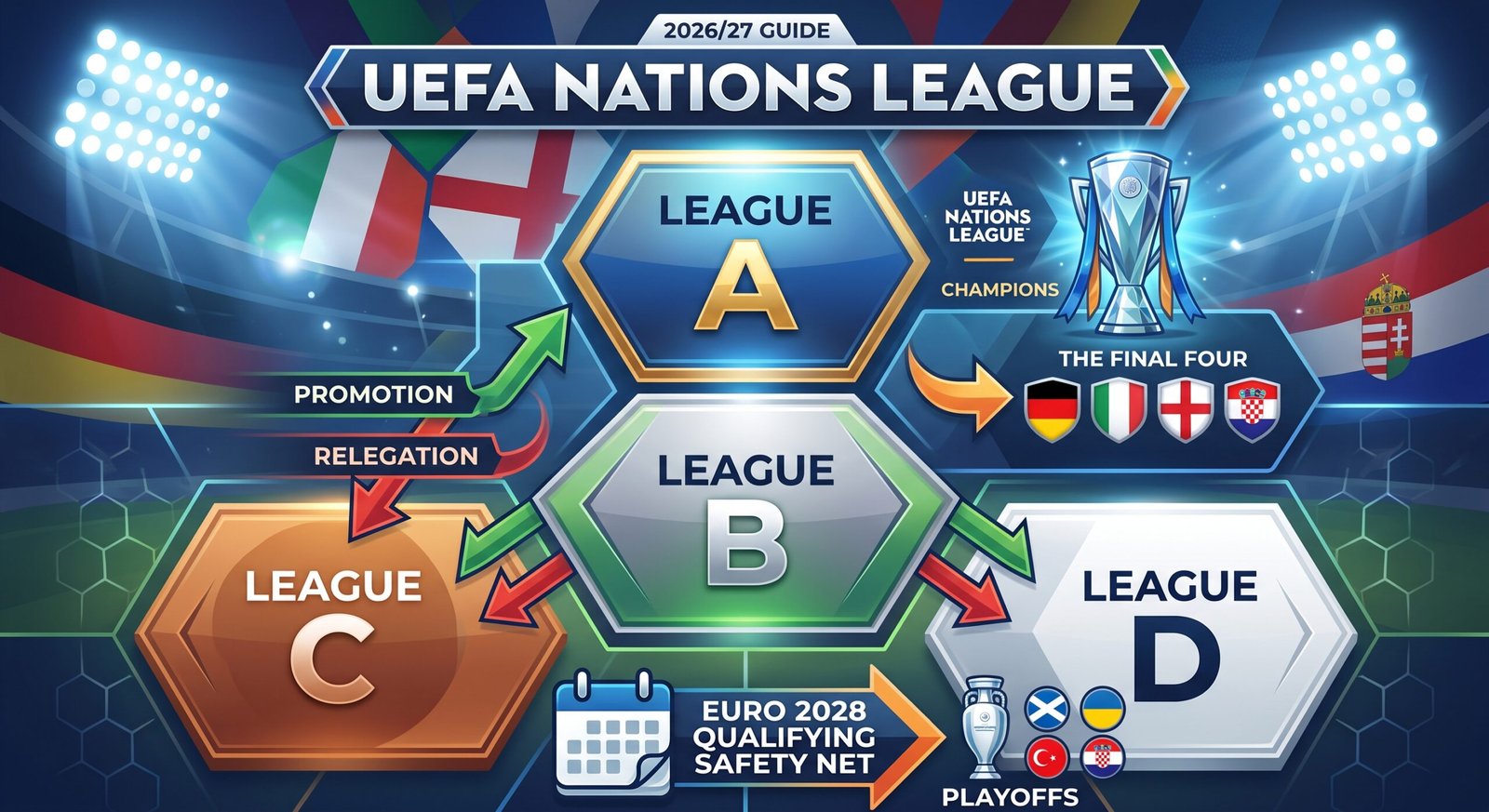
International friendly matches once dominated the autumn sports calendar, drawing criticism from fans, managers, and players for their lack of competitive stakes. To solve this, UEFA introduced the UEFA Nations League in 2018. The competition replaces meaningless exhibition games with structured, competitive league play featuring trophies, promotion, relegation, and pathways to major international tournaments.
Despite its growing prestige, the tournament’s multi-tiered system and evolving bracket formats continue to puzzle casual spectators. Here is the definitive breakdown of how the UEFA Nations League operates, how the leagues are organized, and why every fixture matters.
1. The League Structure: Dividing Europe’s 54 Nations
The UEFA Nations League divides Europe’s 54 participating national associations into four distinct divisions—League A, League B, League C, and League D—based on their performance in the previous edition of the tournament.
- League A: Features the 16 top-ranked teams in Europe, split into four groups of four. This is the only division competing directly for the championship trophy.
- League B: Features 16 mid-tier national sides competing in four groups of four, all fighting for promotion to the top flight.
- League C: Comprises 16 developmental and lower-middle tier nations across four groups of four.
- League D: The entry-level tier, containing the remaining 6 lowest-ranked nations split into two groups of three teams.
In Leagues A, B, and C, each nation plays six matches (three home, three away) against the opponents in their group. In League D, teams play four matches.
| League | Number of Teams | Group Setup | Key Objective |
| League A | 16 | 4 groups of 4 | Win the trophy; avoid relegation |
| League B | 16 | 4 groups of 4 | Earn promotion to League A; avoid relegation |
| League C | 16 | 4 groups of 4 | Earn promotion to League B; avoid relegation |
| League D | 6 | 2 groups of 3 | Earn promotion to League C |
2. Deciding the Champion: The Quarterfinals and Finals
Winning the UEFA Nations League requires advancing through a knockout phase reserved exclusively for League A.
Under the updated tournament regulations, group performance leads to an expanded knockout path:
- Group Stage: The four group winners and the four group runners-up from League A advance to the knockout rounds (8 teams total).
- Two-Legged Quarterfinals: Held in the March international window, the top two teams from each League A group play a home-and-away knockout tie.
- Nations League Finals: The four quarterfinal winners travel to a single host country for the finals mini-tournament in June. This stage consists of single-elimination semifinals, a third-place playoff, and the final to crown the UEFA Nations League Champion.
3. Promotion, Relegation, and the Playoff System
The core feature driving intensity in every Nations League fixture is the threat of relegation and the reward of promotion. Teams do not stay locked into their respective leagues from year to year.
Direct Promotion and Relegation
- League B to A: The four group winners in League B earn automatic promotion to League A for the following cycle.
- League A to B: The bottom-finishing team in each League A group is automatically relegated to League B.
- League C to B: The four group winners in League C advance to League B.
- League D to C: The winners of League D earn promotion into League C.
Promotion/Relegation Playoff Ties
To keep middle-tier games meaningful through the final matchday, UEFA utilizes a two-legged playoff system played in March:
- League A vs. League B Playoffs: The 3rd-placed teams in League A face the 2nd-placed runners-up from League B. The winner earns or retains a spot in League A, while the loser plays in League B.
- League B vs. League C Playoffs: The 3rd-placed teams in League B face the runners-up from League C over two legs.
- League C vs. League D Playoffs: The lowest-ranked 4th-placed teams in League C play off against the runners-up of League D.
4. How the Nations League Affects Euro and World Cup Qualification
The biggest point of confusion for many supporters is the relationship between the Nations League and major tournament qualification (such as the UEFA European Championship or FIFA World Cup).
Key Rule: Teams cannot win automatic qualification to the UEFA European Championship or World Cup via the Nations League alone. However, the Nations League provides a crucial second-chance safety net through qualification playoffs.
Here is how the qualification link works:
- The Primary Qualifying Campaign: Most tournament berths are awarded through standard European Qualifiers, where teams are drawn into groups and the top finishers qualify directly.
- The Nations League Safety Net: National teams that fail to finish in qualifying spots during standard group qualifiers can still qualify for the European Championship via the playoffs.
- Awarding Playoff Berths: These playoff berths are allocated based on Nations League ranking. The best-performing group winners from Leagues A, B, and C that have not already booked their tickets receive priority seeding in the playoff brackets.
This system offers massive value to mid-tier and developing footballing nations. Smaller nations that dominate their Nations League tier can secure a high-stakes single-match playoff against equivalent competition, opening a direct door to major international tournaments.
5. Why the Tournament Has Succeeded
When the competition was first announced, skeptics dismissed it as a re-branded exhibition circuit. Over multiple editions, several factors have solidified its status as an essential football fixture:
- Competitive Balance: Smaller nations are no longer subjected to repeated 6-0 defeats against continental giants; they face opponents at their own developmental level, fostering tactical improvement and spectator interest.
- High-Stakes Clashes: League A serves as a recurring mini-European Championship, regularly pitting giants like France, Spain, Germany, and England against each other in competitive matches.
- Financial Incentives: Participating associations receive significant solidarity payments and prize money from UEFA, providing crucial revenue for grassroots football and domestic development programs.
Frequently Asked Questions
Does the Nations League replace the European Championship?
No. The European Championship (the Euros) remains UEFA’s premier continental championship held every four years. The Nations League is a separate tournament contested across a two-year cycle.
How often is the Nations League played?
The Nations League operates on a two-year cycle. Group stages take place in the autumn international windows, while the quarterfinals, playoffs, and final four take place the following spring and summer.
Who has won the Nations League in the past?
Previous champions include Portugal (2019 and 2025), France (2021), and Spain (2023).
Leave a Reply