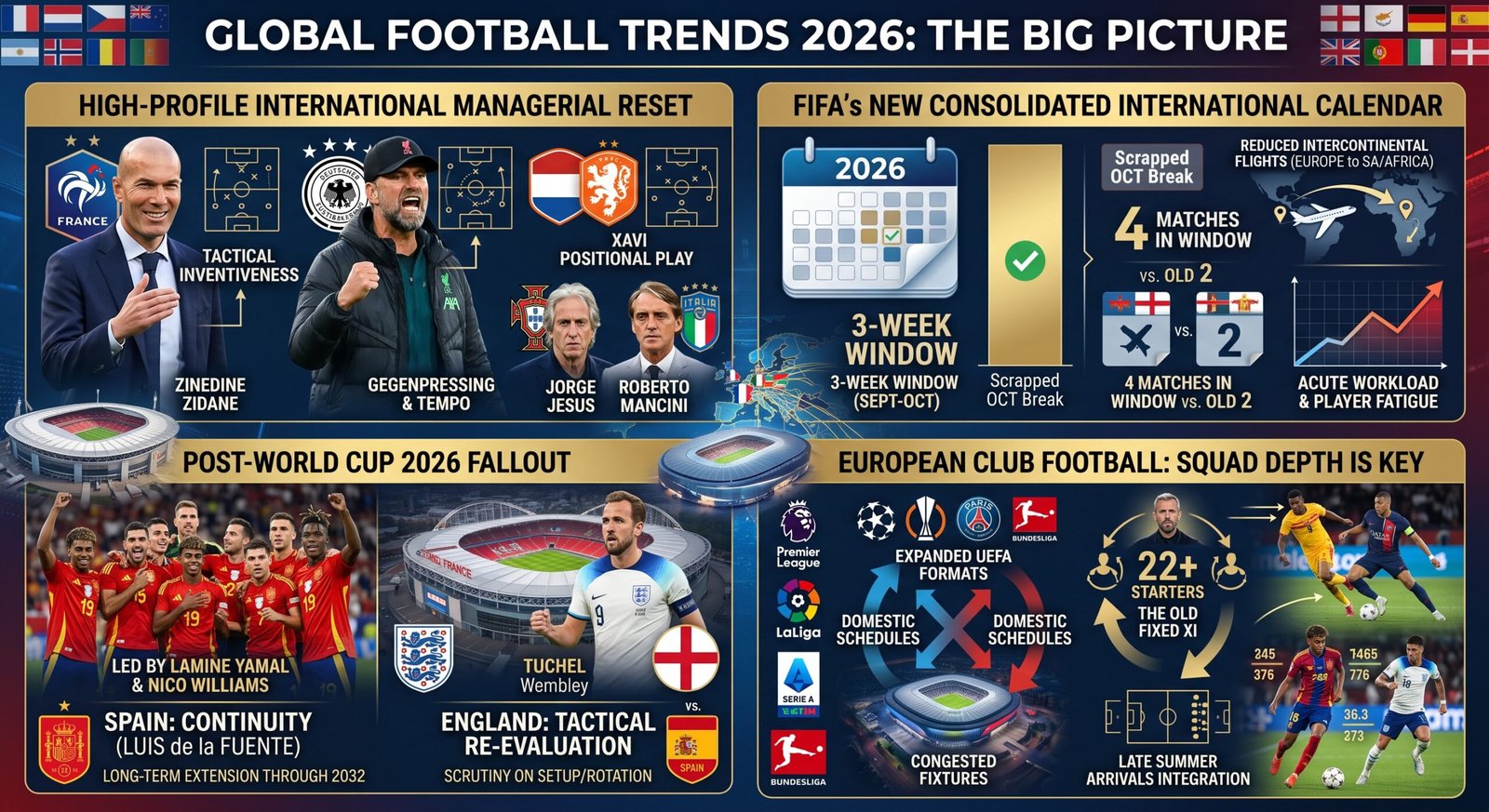
The global football landscape in 2026 is undergoing one of its most transformative periods in modern history. Coming off the heels of an unprecedented summer international tournament cycle, the sport is navigating a radical reshuffle: iconic managers stepping into national team dugouts, FIFA rolling out a structural overhaul of the international match calendar, and domestic leagues adjusting to intense fixture loads.
From Europe’s top-flight divisions to international showdowns across South America and Africa, here is an in-depth breakdown of the major trends defining world soccer today.
1. The High-Profile International Managerial Reset
Following the conclusion of the World Cup cycle, several elite football federations made seismic appointments. The transition from club management to national team setups has brought tactical modernization to the international arena.
Zinedine Zidane Takes the Reins of France
After years of speculation following Didier Deschamps’ historic tenure, Zinedine Zidane has officially taken charge of Les Bleus. The appointment represents both continuity and tactical reinvention. Zidane inherited a squad brimming with world-class talent, led by captain Kylian Mbappé.
Zidane’s immediate focus has centered on balancing tactical freedom with structural defensive solidity. Early competitive tests in the UEFA Nations League against disciplined sides like Turkey and Belgium provide a clear preview of how France aims to build their next cycle around dynamic transitions and fluid wide play.
Jürgen Klopp’s Tactical Blueprint for Germany
Following Julian Nagelsmann’s departure, Jürgen Klopp stepped into the international spotlight as the manager of the German national team (DFB-Team). Known worldwide for his trademark Gegenpressing and high-octane tempo, Klopp’s arrival has injected immediate energy into a German squad seeking tactical identity.
Klopp has widened the selection pool, blending established veterans with emerging Bundesliga talent. Facing top-tier opposition such as the Netherlands, Germany’s transition play, counter-pressing intensity, and high defensive lines have quickly become focal points for tactical analysts worldwide.
Tactical Shifts Across Europe: Xavi, Jorge Jesus, and Roberto Mancini
- Xavi Hernández (Netherlands): After departing club football, Xavi’s appointment to guide the Dutch national team has shifted the Oranje toward positional play, structured midfield possession, and aggressive spatial control.
- Jorge Jesus (Portugal): Bringing his signature direct attacking mindset and aggressive off-ball pressing, Jesus represents a stylistic evolution for a talent-rich Portuguese squad.
- Roberto Mancini (Italy): Returning to the helm of the Azzurri, Mancini has initiated another squad rebuild, prioritizing technical youth profiles across Serie A to revitalize Italy’s midfield and frontline productivity.
2. FIFA’s Consolidated Calendar Overhaul: The 3-Week Window Debate
One of the biggest operational stories in world football is the execution of FIFA’s reformed Men’s International Match Calendar.
What Changed?
Historically, the autumn international schedule was split into two separate breaks: a two-match window in September, followed by another two-match break in October. Under the revised framework, FIFA consolidated these into a single, extended three-week international window.
| Feature | Old Calendar Format | New Consolidated Format (2026/27) |
| Window Structure | Two separate windows (Sept & Oct) | One extended window (Sept–Oct) |
| Match Allocation | Up to 2 matches per window | Up to 4 matches in single window |
| Travel Requirements | Intercontinental travel twice in 5 weeks | One round-trip travel block |
| Club Disruption | League schedules stopped twice | One break, followed by uninterrupted club run |
Player Welfare vs. Travel Efficiency
The rationale behind the consolidation was straightforward: reduce international flight miles and mitigate acute jet lag for South American (CONMEBOL), African (CAF), and Asian (AFC) players competing in European leagues.
However, the change has generated fierce debate among club managers and medical staff:
- The Benefit: Uninterrupted club football through late autumn, allowing domestic leagues and UEFA club competitions to maintain rhythm without constant mid-season halts.
- The Concern: National teams are now packing four high-intensity competitive fixtures into a 16-to-18-day stretch. For players already carrying heavy summer minutes, the physical load has heightened scrutiny around muscle fatigue, recovery protocols, and rotational depth.
3. Post-Tournament Fallout: New Dynasties and Tactical Re-evaluations
The reverberations of the summer’s premier international tournament continue to dictate squad selections and media narratives worldwide.
Spain’s Era of Continuity Under Luis de la Fuente
Reigning supreme on the international stage, Spain’s Royal Spanish Football Federation (RFEF) locked in Luis de la Fuente with a long-term contract extension through 2032. La Roja continue to set the benchmark for modern international football. Their setup marries traditional Spanish positional dominance with explosive verticality from young wingers like Lamine Yamal and Nico Williams, making them the standard against which all top nations measure themselves.
England Under Thomas Tuchel
For England, the tactical direction under Thomas Tuchel remains under a bright spotlight following high-stakes tournament knockout exits. Tuchel’s mandate is clear: translate one of the most valuable player rosters in the world into a coherent, tournament-winning machine.
Tuchel’s early competitive fixtures, including blockbuster clashes against Spain at Wembley, show a push toward pragmatic game management, positional discipline, and a more structured pressing scheme off the ball.
4. Club Football Dynamics: Squad Depth as the Ultimate Competitive Advantage
Domestically, the Premier League, La Liga, Serie A, and the Bundesliga are seeing tactical changes driven directly by congested calendars and expanded European cup formats.
                    MODERN SQUAD SUCCESS FACTORS
 ┌─────────────────────────────────────────────────────────────┐
 │  Tactical Fluidity      Load Management     Deep Rotation   │
 │  (Multi-role players)   (Minutes monitoring)(22+ starters)  │
 └───────────────────────────────┬─────────────────────────────┘
                                 │
                                 ▼
 ┌─────────────────────────────────────────────────────────────┐
 │       Sustained Competitiveness Across 60+ Match Season     │
 └─────────────────────────────────────────────────────────────┘
The Death of the Fixed Starting XI
Top-tier managers are no longer building around an untouchable “Starting Eleven.” With teams facing upwards of 60 to 65 matches across domestic leagues, domestic cups, and expanded European formats, elite clubs operate with a concept of “20 to 22 starting-caliber players.”
Managers across Europe have leaned heavily into tactical flexibility:
- Inverted Full-backs & Hybrid Midfielders: Players capable of shifting between defensive lines and central midfield during build-up are prioritized to minimize tactical drop-off during rotations.
- Aggressive Five-Substitution Usage: Tactical substitutions before the 60-minute mark have shifted from an emergency measure to a pre-planned athletic management strategy.
Summer Signing Integration
September and October serve as the true litmus test for summer transfers. Newly signed center-forwards and box-to-box midfielders are undergoing intensive tactical integration. The pressure to deliver immediate points before mid-season continental schedules intensify leaves little room for slow acclimation.
The Road Ahead
Global football in 2026 is defined by adaptation. Between the tactical elevation of international management under icons like Zidane and Klopp, the operational reality of FIFA’s condensed scheduling, and the relentless physical demands of the club game, success now belongs to teams that master sports science, tactical flexibility, and squad depth.
As the domestic seasons ramp up and the new international calendar tests player endurance, the tactical innovations deployed today will establish the blueprint for world football over the decade ahead.
Leave a Reply