What Is the Half Space in Football? Modern Tactics Explained
Modern football analysis is full of specialized terminology: low blocks, inverted full-backs, PPDA, and transitions. Yet few phrases are used more frequently by tactical analysts and elite managers than the half space in football.
Once an obscure concept discussed primarily in tactical coaching clinics, understanding the half space has become essential for anyone wanting to decipher modern tactics. Whether analyzing Manchester City’s fluid positional play, Arsenal’s set structures, or Real Madrid’s dynamic combinations, the decisive moments in the world’s biggest matches consistently unfold in these specific areas of the pitch.
What exactly is the half space, why is it so lethal, and how do managers exploit it to break down compact defensive structures?
What Is the Half Space in Football?
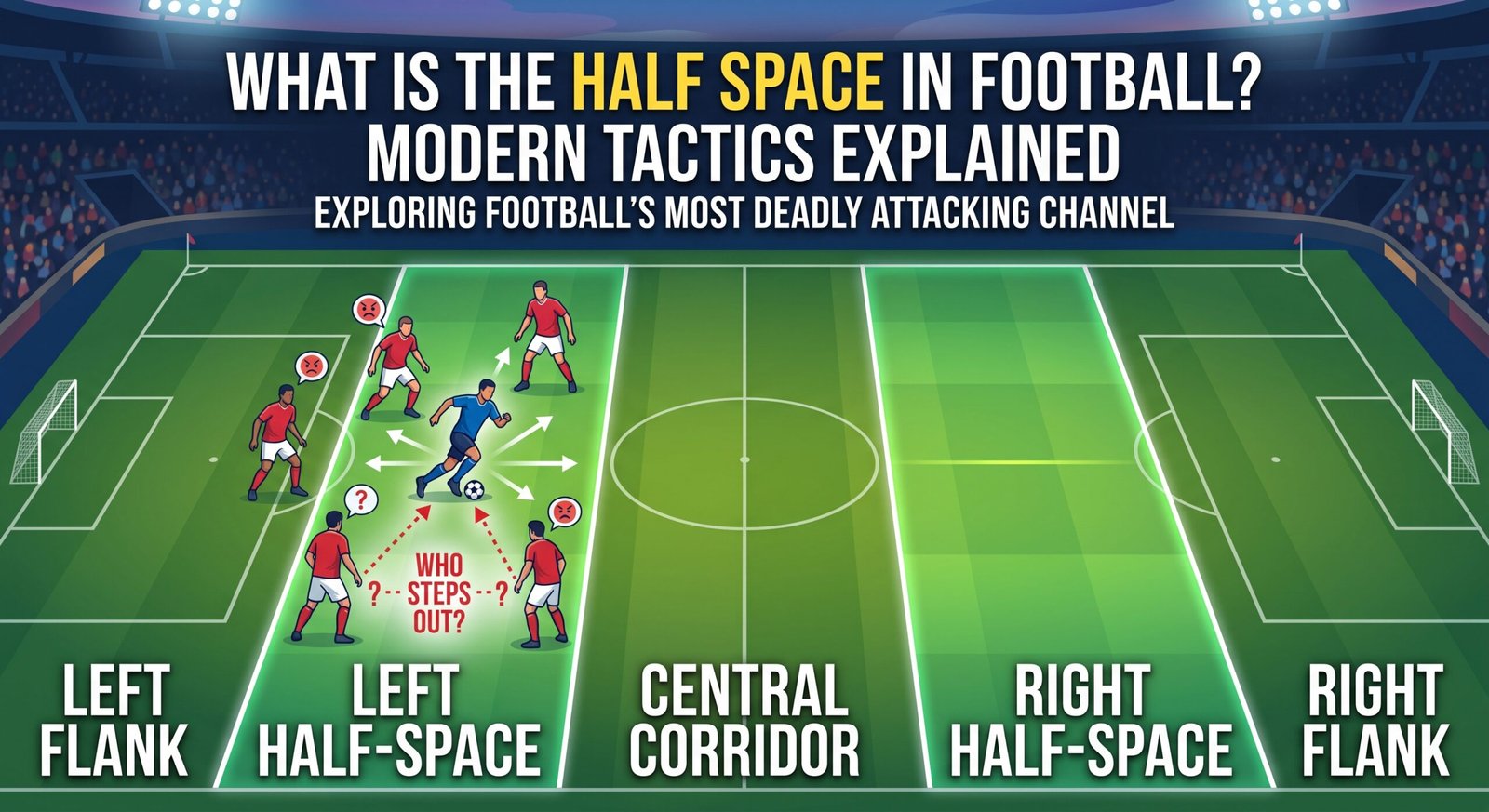
To understand the half space, start by dividing a standard football pitch vertically into five distinct corridors rather than the traditional three (left wing, center, right wing).
+---------------+---------------+---------------+---------------+---------------+
|   Left Wing   | Left Half-Sp. | Central Zone  | Rt. Half-Sp.  |  Right Wing   |
+---------------+---------------+---------------+---------------+---------------+
The pitch features:
- Left Flank / Wing: The wide corridor bordering the left touchline.
- Left Half Space (Halbraum): The intermediate channel situated between the left wing and the central area.
- Central Corridor: The middle lane encompassing both penalty boxes and the center circle.
- Right Half Space: The intermediate channel between the central zone and the right wing.
- Right Flank / Wing: The wide corridor bordering the right touchline.
The term originates from the German coaching concept Halbraum. In standard pitch markings, the half spaces align roughly with the width extending from the edge of the six-yard box to the outer edge of the 18-yard penalty area.
Occupying the half space means positioning a player neither directly down the congested center nor stuck out wide on the touchline. That intermediate positioning creates structural dilemmas for defending teams.
Why Is the Half Space So Dangerous?
Defensive setups are traditionally trained to manage two simple reference points: the center (protect the goal) and the wide areas (protect the cross). The half space disrupts this defensive logic in three key ways:
1. 360-Degree Passing Angles
When a playmaker receives the ball on the wide touchline, their field of view and passing range are sliced in half by the sideline; opponents can use the touchline as an extra defender. Conversely, receiving the ball directly in the center often comes with heavy pressure from center-backs and defensive midfielders with their backs to goal.
In the half space, a player faces the opposition goal diagonally. This diagonal body orientation allows them to:
- Slip through-balls between the opponent’s center-back and full-back.
- Switch play diagonally to an isolated winger on the opposite flank.
- Shoot directly on goal with a natural curling angle.
- Combine with short 1-2 passes through central defensive midfielders.
2. The Defensive Dilemma: Who Steps Out?
Defending the half space introduces structural conflict into an opponent’s back line:
- If the full-back pinches inside to close down the attacker in the half space, they vacate the wing, leaving the attacking team’s winger completely unmarked in crossing territory.
- If the center-back steps out wide, a gaping hole emerges in the heart of the central defense for trailing runners to exploit.
- If a central midfielder drops back, they concede control of the edge of the penalty box, inviting cut-backs and long-range shooting opportunities.
3. Asymmetrical Diagonal Passing Lines
Horizontal passes are easy to track and intercept; purely vertical passes are predictable and run straight into back lines. Diagonal passes delivered from the half space cut through defensive lines at an angle that forces defenders to turn their bodies and rearrange their footwork while tracking running opponents, creating miscommunication and tracking errors.
How Elite Managers Exploit the Half Spaces
Modern managers build entire attacking philosophies around creating overloads within these two vertical channels.
The Underlapping Full-Back
Traditionally, full-backs made “overlapping” runs—sprinting around the outside of their winger down the touchline. In modern systems, managers frequently instruct full-backs to make underlapping runs.
When the winger stays wide to pin the opposing full-back to the touchline, the attacking full-back charges directly through the vacated half space channel, receiving the ball behind the back line to deliver low cut-backs.
Inverted Wingers and Inside Forwards
Wingers who play on the side opposite their natural strong foot (e.g., a right-footed player on the left wing) rarely stay glued to the sideline. Instead, they drift diagonally inside into the half space. This movement allows them to shoot on their stronger foot or deliver inswinging crosses into the “corridor of uncertainty” between the goalkeeper and the last defender.
The Free “Eight” (Interior Midfielders)
In a standard 4-3-3 formation, advanced central midfielders operate as “interiors.” Rather than holding deep central positions, they push into the half spaces between the opponent’s defensive and midfield lines. By positioning themselves directly in the gaps of a defensive mid-block, they act as primary progressors who turn defensive possessions into goal-scoring chances.
Central Channel vs. Half Space vs. Wide Corridor
| Tactical Attribute | Wide Wings | Half Spaces | Central Channel |
| Defensive Density | Low | Medium | High |
| Passing Trajectory | 180° (limited by touchline) | 360° (diagonal & multi-lane) | 360° (congested lanes) |
| Direct Goal Threat | Low (cross-dependent) | High (curled shots & direct runs) | Highest (optimal shot distance) |
| Primary Actions | Crosses, isolations, 1v1 dribbles | Through-balls, underlaps, diagonal switches | Rebounds, hold-up play, direct headers |
Summary: The Defining Tactical Zone of Modern Football
The half space is no passing tactical fad; it is the natural evolutionary response to increasingly organized, compact defensive blocks. By splitting the pitch into five lanes instead of three, modern coaches have turned these intermediate channels into football’s most potent offensive weapon.
Next time you watch a top-flight match, take your eyes off the ball for a few sequences and watch the spaces between the opposing center-back and full-back. The team that controls those two narrow strips of grass is almost always the team dictating the outcome of the match.
Leave a Reply