Manchester City 115 Financial Charges Explained: Verdict, Punishments, and What Happens Next
The unprecedented legal showdown between Manchester City and the Premier League has reached a critical turning point. Following a multi-year investigation and a closed-door hearing before an independent regulatory commission, football fans around the world are asking the same questions: What were the charges? What sanctions could the club face? And could past Premier League titles actually be stripped?
Here is a comprehensive breakdown of the entire case, the potential sporting penalties under Premier League regulations, and the long-term ramifications for modern football.
What Are Manchester City’s 115 Charges?
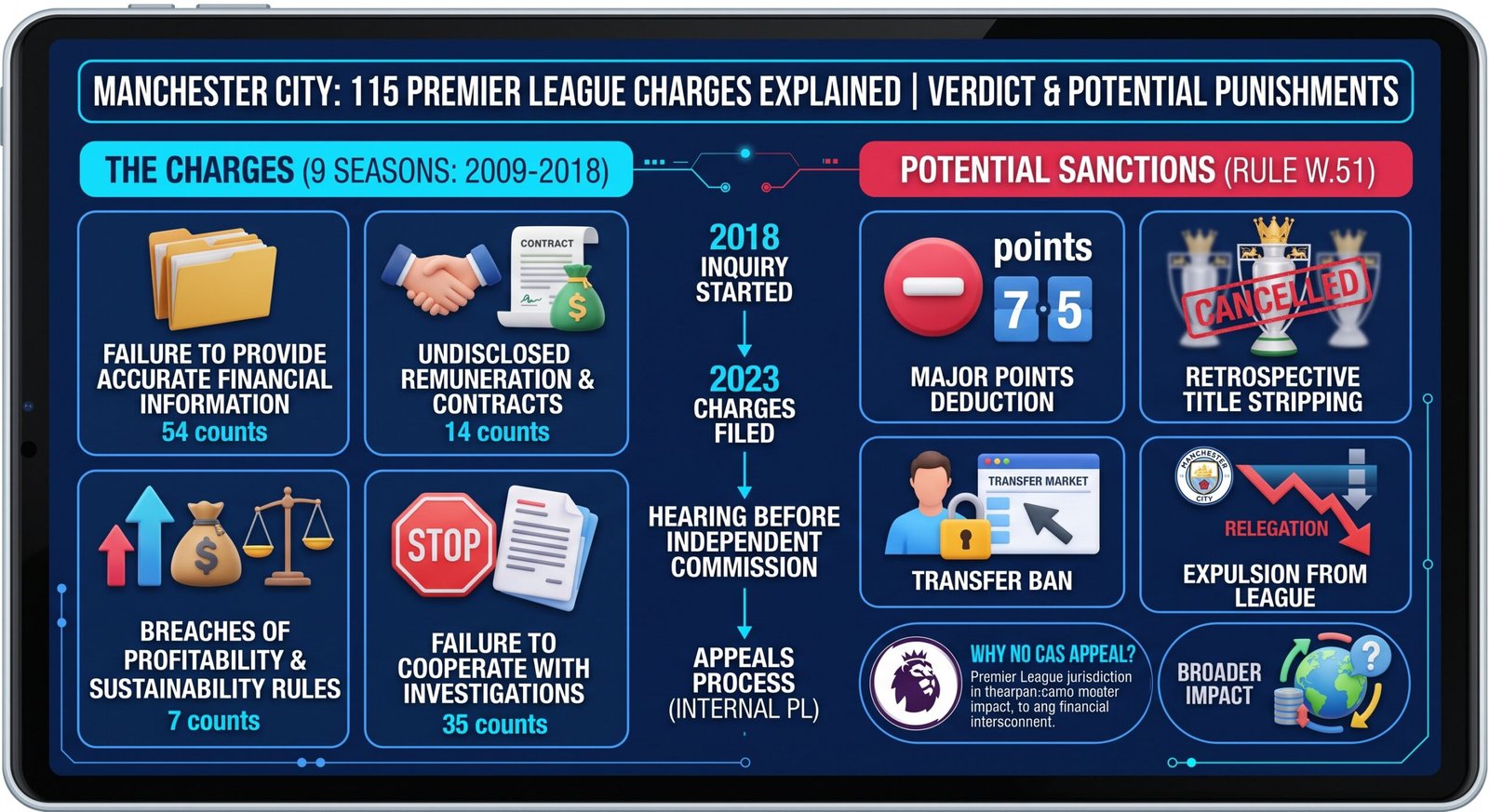
The charges against Manchester City stem from an extensive Premier League inquiry initiated in late 2018 after internal documents and emails were published by European media outlets. In February 2023, the Premier League formally charged the club with 115 alleged breaches spanning nine seasons (from the 2009–10 campaign through 2017–18).
The 115 charges broadly fall into four main categories:
- Failure to Provide Accurate Financial Information (54 counts): The Premier League requires member clubs to submit accounts providing a “true and fair view” of their revenue streams, specifically related to sponsorship values and operating overhead.
- Undisclosed Remuneration & Contracts (14 counts): Allegations that payments to former managers (such as Roberto Mancini) and high-profile players were routed through third-party entities rather than declared through official club payroll.
- Breaches of Profitability & Sustainability Rules (7 counts): Violations regarding Premier League financial sustainability frameworks and UEFA Financial Fair Play (FFP) benchmarks during overlapping assessment cycles.
- Failure to Cooperate with Investigations (35 counts): Alleged refusal to provide documents, source files, and direct access requested by Premier League investigators between 2018 and 2023.
Manchester City have consistently and vigorously denied all allegations, asserting they have an “irrefutable body of evidence” demonstrating full financial compliance.
Potential Sanctions Under Premier League Rule W.51
Unlike traditional courtrooms with strict mandatory minimums, the independent panel hearing the case possesses virtually unlimited discretionary power under Sub-clause W.51.7 of the Premier League handbook.
| Sanction Category | Likelihood | Impact on the Club |
| Substantial Financial Fines | Guaranteed / High | High monetary penalty, minimal direct sporting damage. |
| Current Season Points Deduction | High | Could derail European qualification or title contention. |
| Transfer Ban (1–2 Windows) | Moderate | Freezes squad rebuilds; forces reliance on academy players. |
| Retrospective Points Deductions | Low to Moderate | Could theoretically alter past league tables and title records. |
| Expulsion / Relegation | Low | The nuclear option: stripping membership and demoting to EFL. |
1. Significant Points Deductions
The Premier League previously set clear precedents by issuing immediate point deductions to clubs like Everton and Nottingham Forest for comparatively narrower Profitability and Sustainability Rule (PSR) breaches. Given the unprecedented scope of the City charges, any deduction applied in an active season could range from 15 to 30+ points, severely compromising domestic league positioning.
2. Retrospective Title Stripping
Between 2011 and 2018, Manchester City lifted three Premier League crowns (2011–12, 2013–14, and 2017–18). If the commission enforces points deductions applied retroactively to those specific campaigns, historical league standings could mathematically shift. However, sports law analysts frequently note that regulatory bodies have historically been hesitant to reallocate silverware years after the fact due to the logistical chaos and potential litigation from secondary clubs.
3. Expulsion from the Premier League
The ultimate penalty under Rule W.51 is complete termination of club membership. While legally possible, full expulsion requires extreme justification. A penalty of this magnitude would likely result in an immediate descent into the English Football League (EFL) pyramid, subject to the EFL’s own admission guidelines.
Why Can’t Man City Take This to the Court of Arbitration for Sport (CAS)?
In 2020, Manchester City successfully overturned a two-year UEFA Champions League ban by taking their case to CAS in Lausanne, Switzerland, where several charges were deemed time-barred under UEFA’s statute of limitations.
The Premier League process is fundamentally different:
- The Premier League’s rulebook does not recognize CAS jurisdiction for internal member disputes.
- There is no statute of limitations within Premier League financial regulations, meaning ancient filings from 2009 remain fully actionable.
- Once the independent panel delivers its liability and sanctions verdicts, City can only appeal to a new, internal Premier League Appeals Board. Further legal escalation would be restricted to procedural challenges in UK civil courts (e.g., judicial review of arbitration fairness).
Timeline: What Happens Next?
The resolution of the dispute follows a multi-tiered legal schedule:
- Liability Assessment: The independent panel reviews evidence and rules on whether specific breaches occurred across each individual charge.
- Sanction Hearings: If liability is established on substantial counts, a dedicated penalty hearing convenes to evaluate arguments on mitigating factors, precedent, and proportionality.
- Appeals Process: Either side has the legal right to challenge findings before an appeals panel, a step almost certain to occur given the stakes.
- Final Implementation: Enforced sporting penalties (such as point reductions or transfer suspensions) will only be applied once all formal appeal routes under the league charter are exhausted.
The Broader Impact on Global Football Finance
The resolution of this case will permanently reshape the football landscape. A decisive ruling in favor of the Premier League would reinforce domestic financial governance and send a clear deterrent to sovereign-backed or multi-club ownership models across Europe.
Conversely, if the allegations fail to hold up under scrutiny or receive minor reprimands, rival top-flight clubs will aggressively push to overhaul current financial restrictions in favor of higher spending thresholds to remain competitive on the international stage.
Frequently Asked Questions (FAQ)
Can Manchester City lose their Champions League trophies?
No. The current charges involve domestic Premier League financial regulations. UEFA runs its own distinct licensing framework, and the European governing body already concluded its previous proceedings with the club in 2020.
Would rival clubs receive compensation?
Should City be found liable for sustained financial breaches, rival clubs that missed out on European qualification, prize money, or domestic titles during that 2009–2018 window could lodge civil claims for financial damages.
When will the final verdict be enforced?
Due to expected appeal procedures and administrative schedules, a fully resolved and enforceable set of penalties is expected to carry into the subsequent league calendar before all legal remedies conclude.
Leave a Reply